Clay Art Therapy, Self-Discovery and the Journey of Returning to Yourself
Who are you when nobody is watching?
Who are you beneath the roles you play, the responsibilities you carry and the expectations you have learned to meet?
Have you become so good at being who everyone needs you to be that you have forgotten who you are without those roles?
And perhaps the deepest question of all:
Is the face you show the world still serving you, or have you begun serving the face you created?
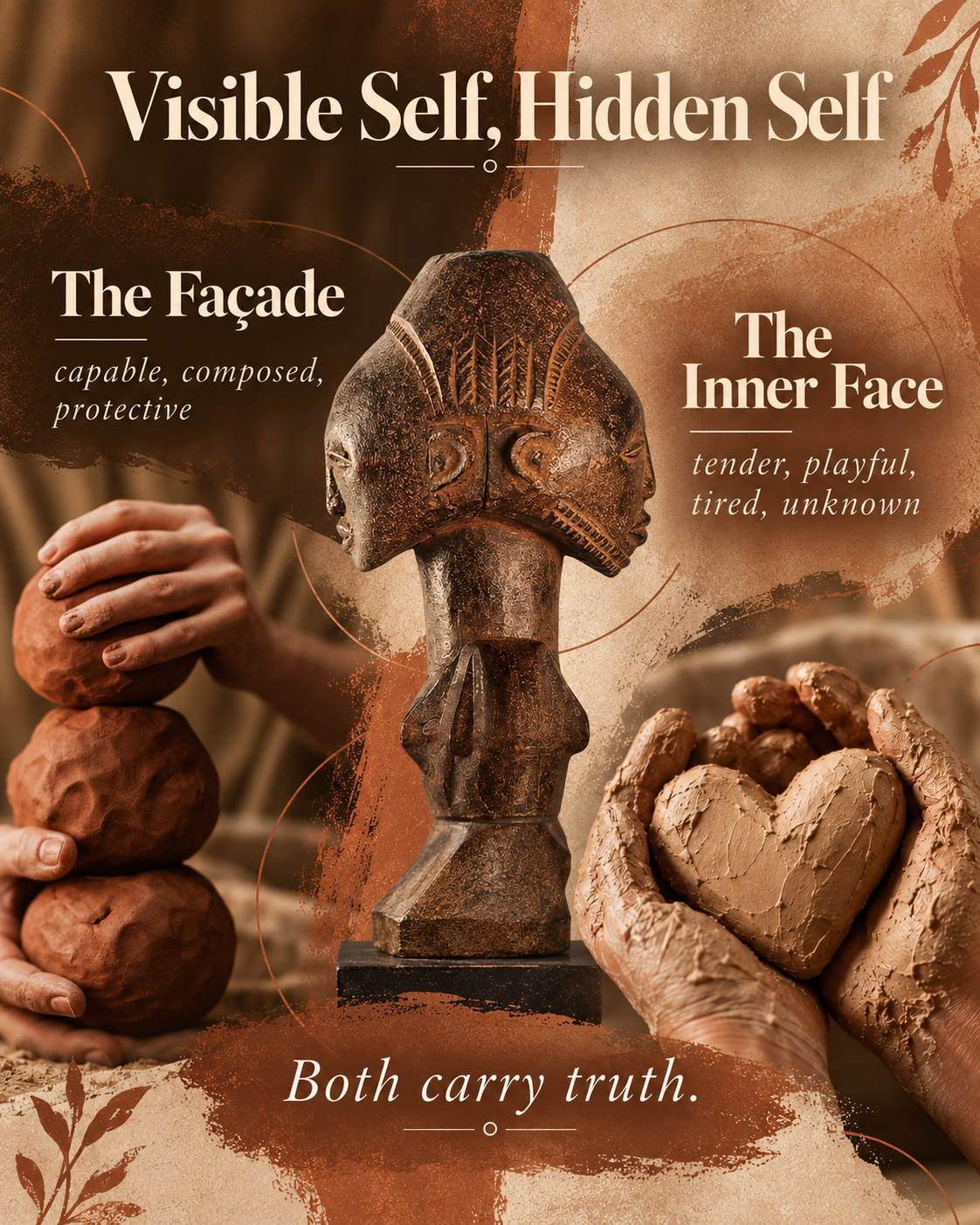
These questions sit at the heart of Visible Self, Hidden Self: The Façade and the Inner Face, a clay art therapy workshop within The Atlas Creative Circle in Cheltenham, Melbourne.
Through storytelling, African sculptural inspiration, somatic awareness and the grounding experience of shaping clay, we explore the relationship between our public identity and the less visible parts of ourselves.
Not to remove our masks, but to understand what they have been protecting.
The Faces We Learn to Wear
From the moment we enter the world, we begin learning who we need to be.
We learn which behaviours bring approval, which emotions are welcome and which parts of ourselves are better kept private.
Perhaps you became the responsible child, the successful professional, the caring parent or the person everyone could depend on.
Perhaps you learned to be strong because vulnerability didn't feel safe.
Or perhaps you became the one who makes everyone else comfortable, even when your own needs remain unheard.
Over time, these identities become familiar.
We stop noticing how much effort it takes to maintain them.
Until one day, something inside begins asking:
Is this really all of me?
The question doesn't necessarily arise because something is wrong. Sometimes it emerges during a life transition, a relationship change, motherhood, burnout or a period of personal growth.
We begin recognising that the person we have become may not fully reflect the person we are becoming.
Carl Jung and the Persona: The Mask That Helps Us Belong
Psychologist Carl Gustav Jung described the persona as the social identity we develop to navigate the outside world.
The word originates from the theatrical mask, representing the role an actor presents to an audience.
In Jungian psychology, the persona helps us adapt to social expectations, build relationships and function within our communities.
It is not inherently false or unhealthy.
Our public identity may contain genuine strengths, values, achievements and qualities we deeply appreciate.
The difficulty begins when we identify so completely with that role that other parts of ourselves no longer have room to exist.
The capable person may struggle to ask for help.
The independent person may find it difficult to receive care.
The endlessly positive person may feel unable to acknowledge sadness.
What happens when the identity that once helped us belong begins limiting who we are allowed to become?
This is where self-discovery begins: not by rejecting our persona, but by developing a more conscious relationship with it.
The Man Without a Name: When the Mask Becomes the Identity
There is a powerful fairy tale by Richard Roberts called The Mask That Wore the Man.
It tells the story of a nameless boy who grows up feeling invisible.
Nobody seems to recognise or remember him. He has no meaningful place in the world.
One day, he discovers travelling actors and watches something extraordinary happen.
As they put on their masks, ordinary people transform into powerful characters, commanding attention, admiration and respect.
The boy realises that perhaps he, too, can create a face the world will recognise.
He spends years crafting a remarkable mask.
And when he finally wears it, everything changes.
People notice him. They celebrate him. He becomes successful, admired and welcomed everywhere.
The mask gives him everything he once longed for.
But eventually, he becomes so accustomed to wearing it that he forgets to remove it.
When he finally tries, he discovers that the mask has become inseparable from his face.
The identity he created to survive has taken over.
The story leaves us with a confronting question:
Are you wearing your identity, or is your identity wearing you?
This is not a story about masks being bad.
It is about forgetting that we are more than the roles we perform.
Two Faces, One Being: Inspiration From African Sculpture
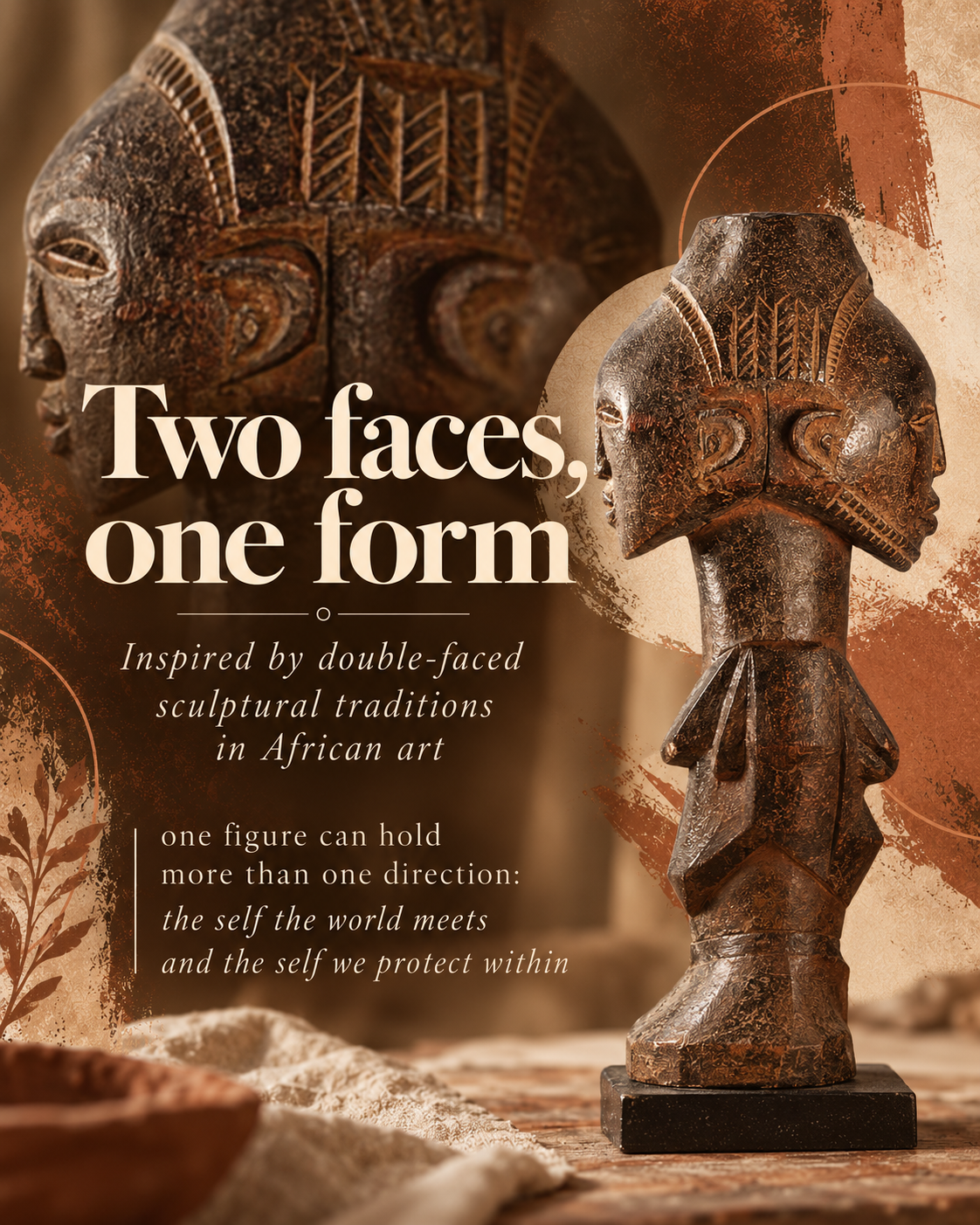
Across several African artistic traditions, sculptors have created remarkable figures with two faces looking in opposite directions.
These are sometimes described in art history as Janus-faced or double-faced sculptures.
One example is the Luba Double-Faced Power Figure, originating from the region now known as the Democratic Republic of the Congo.
Within its original cultural and spiritual context, this sculpture is associated with ancestors, protection and the relationship between visible and invisible worlds.
Its opposing faces evoke complementary dimensions of existence, including past and future, life and death.
These traditional meanings are distinct from modern psychological interpretations.
Yet the image of one figure holding two directions offers a powerful metaphor for personal reflection.
What if our visible and hidden selves are not competing identities, but different expressions of one human being?
One face may hold the qualities that help us navigate everyday life.
The other may carry tenderness, vulnerability, playfulness, uncertainty, anger, unexpressed desires or parts of ourselves we have not yet discovered.
Neither is necessarily more authentic.
Both have their history.
Both have something to contribute.
And both deserve to belong.
Why Explore Identity Through Clay Art Therapy?
There are experiences that words struggle to explain.
We can understand something intellectually yet still find it difficult to feel, express or integrate.
Clay provides a different language.
It has weight, texture and resistance. It responds to touch and records the movement of our hands.
We can press, soften, join, separate and reshape it.
The process invites attention away from constant thinking and towards physical sensation and the present moment.
Research into clay art therapy suggests potential benefits for emotional expression and wellbeing in some clinical settings, although experiences and outcomes vary.
Within the Active Kreative approach, clay is used as a sensory and symbolic medium for exploration rather than a demand to produce beautiful artwork.
We are not sculpting what a face is supposed to look like. We are exploring what it feels like to carry that face.
And sometimes our hands express something before our minds are ready to name it.
The Creative Practice: Sculpting Your Visible and Hidden Self
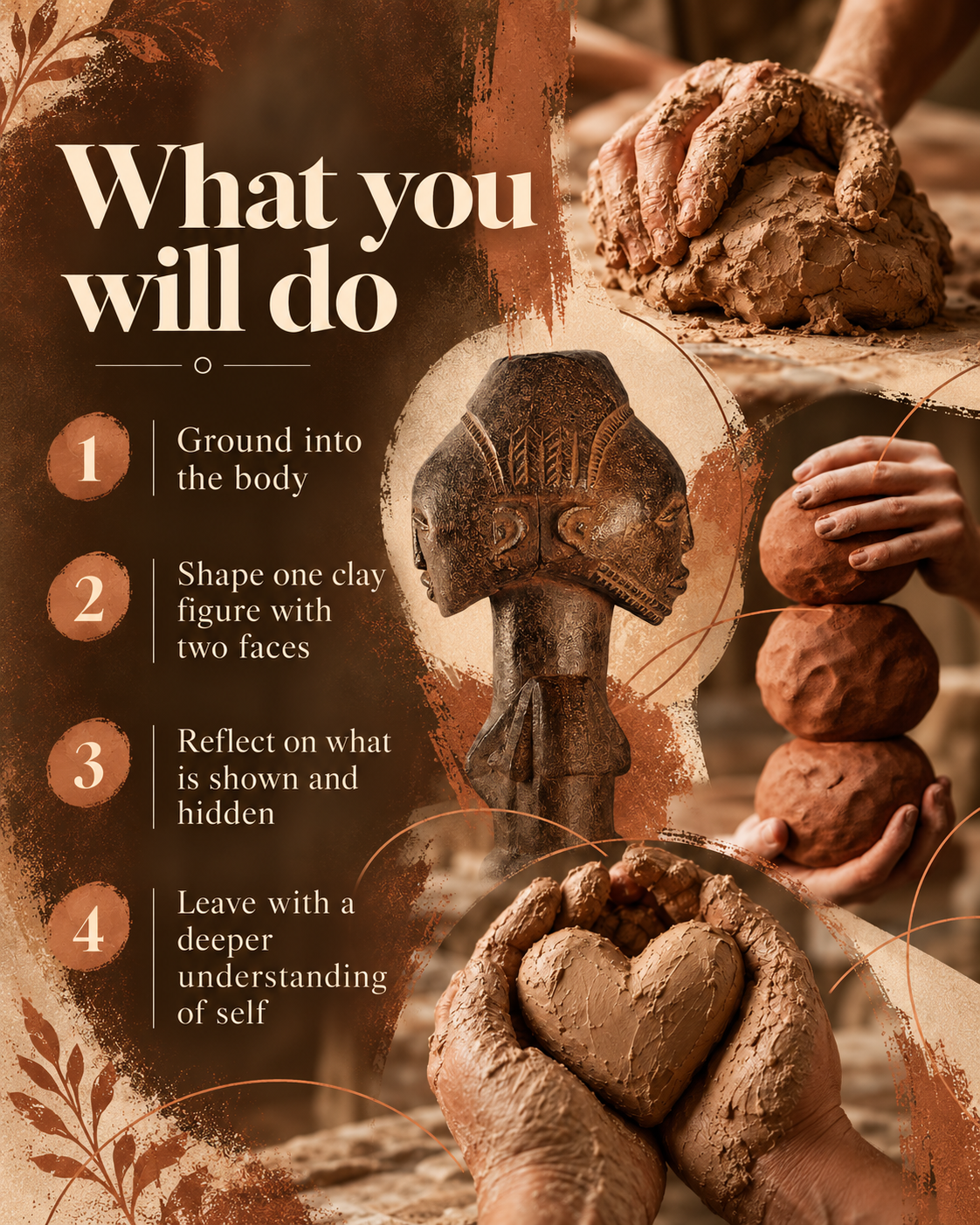
In this guided clay art therapy workshop in Melbourne, participants create one figure containing two faces.
The first represents the Visible Self.
It may be strong, composed, confident, reliable or protective.
As you shape it, you might ask:
Who taught me to become this person? What has this identity helped me achieve? What does maintaining it cost me?
The second represents the Hidden Self.
It may be tender, playful, exhausted, curious, frightened, expressive or entirely unknown.
As your hands begin shaping this face, different questions may emerge:
What have I not given myself permission to express? What part of me needs to be acknowledged? What does this face want me to understand?
Then we bring attention to where the two faces meet.
Do they connect naturally? Is there a boundary between them? Does one dominate? Do they share something unexpected?
The goal is not to make them identical.
It is to recognise that wholeness does not require every part of ourselves to be the same.
Six Questions for Deeper Self-Discovery
Before you begin your own creative reflection, consider sitting quietly with these questions:
Who am I when I am no longer needed by anyone?
Which version of myself receives the most love and acceptance?
What part of me have I learned to hide to protect my belonging?
What identity am I afraid to release, even though it no longer fits?
If my hidden self had a voice, what would it ask me to hear?
Can I honour the person who protected me while making room for the person I am becoming?
You don't need immediate answers.
Sometimes the most important part of reflection is allowing a question to remain open long enough for something new to emerge.
Opening Up Is Not the Same as Exposing Yourself
There is a common misunderstanding that personal growth requires us to reveal everything we have kept hidden.
But opening up does not mean removing every boundary.
It does not mean sharing private experiences with strangers or forcing ourselves into emotional vulnerability.
Integration is not exposure.
You can acknowledge an inner part without explaining it to anyone.
You can appreciate the identity that protected you without continuing to live entirely within it.
You can recognise conflicting feelings without forcing them into agreement.
This is the deeper invitation of The Returning Self.
Not to become a completely new person.
Not to destroy the version of yourself that brought you this far.
But to create enough space for more of yourself to belong.
Join The Atlas Creative Circle in Cheltenham, Melbourne
At Active Kreative, we believe that creativity offers a meaningful way to hear ourselves beyond words.
Our Creative Circle brings together transpersonal art therapy, expressive artmaking, gentle somatic practices and personal reflection in a small, supportive group.
Through Visible Self, Hidden Self, participants are invited to explore the many layers of identity using clay, symbolism and guided self-inquiry.
No artistic experience is required. All materials are provided for in-person workshops, and sharing is always optional.
Location: Cheltenham Community Centre, Melbourne
Creative Circle: Saturdays, 10:30 am–12:30 pm for in-person sessions
Explore The Atlas Creative Circle and upcoming workshops
Perhaps returning to yourself does not mean discovering one final, authentic face.
Perhaps it means recognising the many faces that have carried you through life and allowing them to exist within something greater.
Two faces. One being. A deeper understanding of who you are.
A space to return to yourself through art.