Nature Weaving Therapy
Nature-Weaving Therapy: Reconnecting to the Threads of Self, Nature, and Ancestral Wisdom
In an age where digital noise often drowns the whispers of the soul, many of us long to return to something timeless — a rhythm that beats in harmony with the earth. Nature-Weaving Therapy emerges as one of the most profound ways to reconnect with this ancient rhythm — blending creative expression, cultural tradition, and therapeutic healing into one embodied process.
Before beginning this practice, we acknowledge the Traditional Custodians of the land on which we gather, create, and heal. In Australia, these are the First Nations peoples whose deep relationship with Country continues to guide our understanding of connection, care and reciprocity.
Their seasonal calendars remind us that life moves in cycles, not lines — that every time of year carries its own rhythm, offering materials and energy in balance with the land’s needs. Honoring these ancient ways of knowing helps us practice with humility, awareness, and respect.
This holistic practice, deeply rooted in the Active Kreative Methodology, unites art, nature, and self-discovery through the symbolic act of weaving. It draws from ancestral traditions, eco-psychology, and somatic awareness — helping individuals reconnect with their nervous system, their values, and the cycles of life.
Whether practiced as part of our Creative Circle Workshops or experienced privately in one-on-one sessions, Nature-Weaving Therapy invites participants to gather, weave, and witness — to create art that heals not only the individual but also the collective story we all share.

The Origins of Weaving as a Healing Art
Weaving is one of humanity’s oldest creative acts. Across millennia, cultures from every continent have woven textiles, baskets, and tapestries — not only for survival but also as spiritual expression.
In ancient Greece, weaving symbolized destiny. The Fates, or Moirai, were said to spin and cut the threads of human life. In Indigenous Australian traditions, weaving connected people to the land, ancestry, and Dreamtime stories. In Andean and African cultures, textiles carried codes of identity, prayer, and protection. In Japanese Shinto practices, sacred cords (shimenawa) were woven to mark purity and sacred boundaries.
Each strand, color, and knot carried intention. Each woven object told a story — of belonging, of grief, of love, of transformation.
Modern psychology recognizes this ancient act as deeply symbolic. When we weave, we externalize inner patterns. Threads become metaphors for relationships, memories, and beliefs — and as we untangle or intertwine them, we engage the subconscious in a process of non-verbal transformation.
-
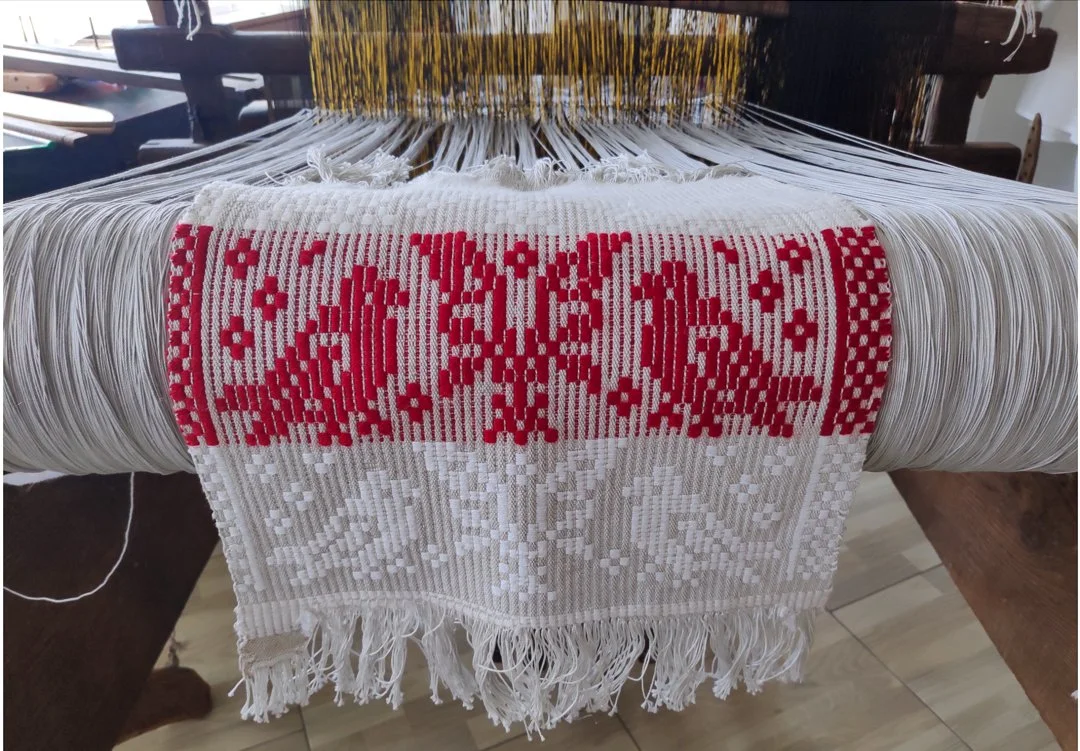
In the heart of Ukraine, weaving has always been more than craft; it is an act of devotion. The rushnyk — a long hand-woven towel embroidered with red and black threads — accompanies every major rite of passage. It blesses newborns, unites couples in marriage, and guards the departed on their final journey. Each motif holds symbolic language: diamonds for fertility, crosses for balance, spirals for the eternal cycle of life.
The rushnyk embodies the Ukrainian belief that threads carry spirit. Women wove in silence at dawn, believing that pure intention infused the fabric with protective energy. Looms stood near windows so that sunlight could weave itself through the warp — a gesture of harmony between the human and divine. In villages, the weaver was often the storyteller, holding in her patterns the myths of the people: of Dazhboh the sun god, of Berehynia the mother-protector, of fields reborn after winter.
-
Far to the west, in ancient Greece, weaving shaped the mythology of destiny itself. The Moirai, or Fates, spun the thread of life, measured it, and finally cut it when a life’s story was complete. The goddess Athena, patron of both wisdom and weaving, taught mortals to interlace order from chaos — her loom symbolising the cosmos in perfect proportion.
Across the Mediterranean, Egyptian tombs reveal linen wrappings finer than silk, believed to preserve the soul for eternity. Each layer of fabric was a veil between worlds, spun from flax that once drank the light of the Nile. The rhythm of weaving — over, under, over, under — echoed the pulse of the universe itself.
-
Description text goes hereIn Persia and the greater Middle East, weaving evolved into a celestial art. Every Persian carpet is a universe in miniature: a centre medallion representing the Source, surrounded by floral spirals that signify creation. Traditional weavers worked from memory, not pattern, improvising like musicians guided by intuition. The rug was laid out in prayer rooms as a bridge between earth and heaven.
Sufi mystics spoke of “weaving the heart’s carpet,” teaching that each repetition of the knot was a mantra. To weave was to surrender the ego — the imperfect hand serving divine geometry. The phrase “God is in the details” was born from this precision, where beauty itself became devotion.
-
Across the African continent, textiles record lineage, authority, and spirit. In West Africa, Kente cloth from the Ashanti people is woven in bright strips whose patterns carry coded messages. Each colour has meaning: gold for royalty, blue for peace, green for growth. To wear a Kente pattern is to speak without words — every thread a proverb.
In North and East Africa, raffia weaving and beadwork honour ancestors and natural cycles. Nigerian Aso-Oke cloth and Ethiopian Gabbi wraps are offered at weddings and births as blessings. In these traditions, the loom is not merely a tool; it is a drum, its rhythm marking time, its sound aligning the weaver with ancestral heartbeat.
-
Item descriptionAmong the Andean peoples of Peru and Bolivia, weaving is considered a direct dialogue with the cosmos. The Quechua word awaska means both “cloth” and “universe.” Alpaca and llama wool are dyed with plants and minerals, connecting colour to the mountain spirits known as Apus. Geometric motifs mirror constellations; weaving becomes a map of the sacred landscape.
In North America, Navajo weavers call their rugs chants made visible. The central diamond represents the opening of the world, and the final loose thread, intentionally left unfinished, allows the spirit of the weaver to escape — a reminder that perfection belongs only to the Creator.
Farther north, among the Coast Salish and Haida, cedar bark and mountain goat wool were woven into ceremonial blankets worn by chiefs and shamans. Each pattern told of lineage, salmon migrations, and the balance between sea and forest.
-
Across Asia, textiles are inseparable from spirituality. In India, silk sarees shimmer with mandalas and lotus motifs that mirror the sacred geometry of temples. Weaving is a meditative act: the weaver repeats the Gayatri mantra, transforming sound into form. The Vedic text Rig Veda even describes creation itself as a woven web of consciousness — “The universe is woven on the loom of time.”
In Japan, the Shinto tradition honours Orihime, the celestial weaver princess whose love story with a cowherd is celebrated during the Tanabata Festival. Silk weaving in Kyoto became a prayer for harmony between heaven and earth. The rhythmic motion of the loom was believed to calm the mind, much like Zen brushwork or the tea ceremony.
In Southeast Asia, Indonesian ikat and Balinese songket incorporate gold and silver threads that catch the light of the divine. In each village, patterns are hereditary — a visual scripture passed through generations of women.
-
In the cold north, Norse mythology speaks of the Norns, three goddesses who spin the fates of gods and humans alike beside the roots of the world tree Yggdrasil. The Anglo-Saxons called destiny wyrd — literally, “that which is woven.” Every human act was a strand in the vast tapestry of time.
Celtic women wove knots with no beginning or end to symbolise eternity. Their interlaced patterns carved in stone and embroidered on cloaks echoed the spirals of nature — shells, vines, and galaxies.
-
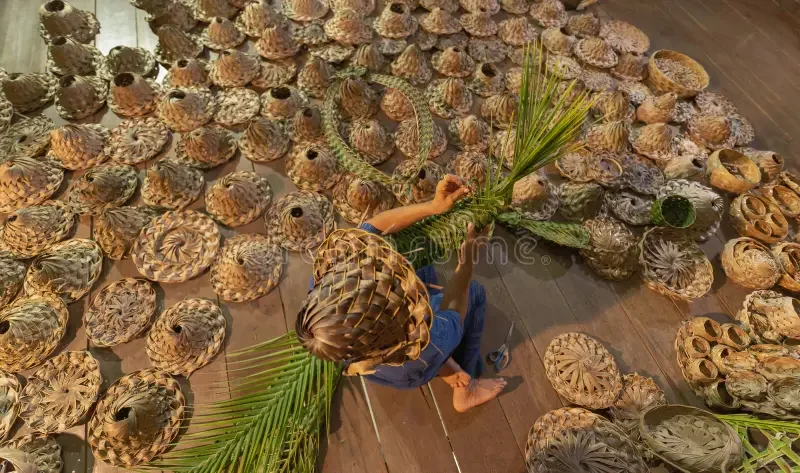
Across Polynesia and Micronesia, weaving binds people to ocean and ancestry. Mats of pandanus leaves are offered in ceremonies, representing both grounding and hospitality. The rhythmic plaiting mirrors the movement of waves. In Māori culture, raranga (weaving) is a sacred exchange between the weaver and the flax plant, performed with prayer and gratitude. Every strand reminds the maker that humans are woven into the greater web of life.
-
From the Ukrainian rushnyk to the Persian carpet, from Andean ponchos to Polynesian mats, one truth endures: weaving is the language of connection. It links generations, elements, and dimensions. It is how humanity prays with its hands.
In today’s creative and therapeutic practices — such as Nature-Weaving Therapy within the Active Kreative approach — this ancestral act is reborn. When we gather twigs, wool, and leaves to weave our own stories, we join a lineage thousands of years old. Each strand reminds us that creation and healing are the same movement: over, under, over, under — breath and rhythm, spirit and thread.
In the end, to weave is to remember that we are all part of one vast tapestry, forever unfolding under the patient loom of the universe.

Nature Therapy and the Return to the Body
At the heart of Nature-Weaving is therapy in nature — a direct sensory dialogue with the earth. Through Active Kreative’s nature therapy programs, participants gather materials from their surroundings — fallen sticks, leaves, twigs, feathers, shells, wool — transforming them into personal altars of reflection.
This practice aligns with somatic and polyvagal principles, calming the nervous system through touch, rhythm, and movement. As the hands weave, the body releases. The gentle repetitive motion regulates the vagus nerve, encouraging safety and grounding — activating the parasympathetic state where true healing unfolds.
Modern research supports what ancient wisdom has always known: nature reconnects us to our innate rhythm. Time spent outdoors increases serotonin and oxytocin levels, reduces cortisol, and supports emotional regulation. When combined with creative ritual, this connection becomes not only restorative but transformative.

Nature as Collaborator — A Living Conversation
When we engage in Nature Weaving, we are not simply using natural materials — we are entering into a conversation with the landscape. The sticks, leaves, grasses, and fibers become collaborators, each carrying their own texture, memory, and wisdom. When we gather them gently and weave with awareness, we are invited to listen — to how they bend, how they respond, how they wish to be placed. The practice becomes reciprocal rather than extractive.
Every element we touch — bark, thread, feather — has a story of its own. We are not separate from these stories; we are part of their continuation. Through the act of weaving, we remember that nature is not an object, but a living presence that meets us in the moment. This awareness transforms the creative process into a quiet dialogue of respect and reciprocity. Reciprocity is at the heart of Nature Weaving. It is the art of giving back to the Earth through presence, gratitude, and intention. Instead of taking materials to create something for ourselves, we co-create with nature — offering our attention and care in return. The process teaches us that belonging is not something to acquire; it is something we nurture through relationship.
When we weave, we re-enter this sacred exchange — remembering that the Earth gives unconditionally, and our creativity is one of the ways we give back. The weave becomes a visual prayer for balance between human and more-than-human worlds.
The Active Kreative Framework: From Intention to Integration
The Active Kreative Methodology weaves together art therapy, transpersonal psychology, neurographic drawing, somatic awareness, and sacred geometry to provide a structured yet intuitive pathway to healing and creative awakening Nature-Weaving Therapy embodies this philosophy through a four-stage process that mirrors both the natural and psychological cycles of growth:
1. Initiation — The Gathering
Every weaving begins with intention. Participants enter a reflective state, often through guided meditation or grounding breathwork. Here, they connect with their inner world and set a personal focus — perhaps a value they wish to honor, a wound they wish to release, or a story they’re ready to rewrite.
Natural materials are then gathered, forming the physical and symbolic foundation. This ritual of collection mirrors the Medicine Wheel’s first direction — the East, representing beginnings, illumination, and vision.
You are invited to step outside — literally or metaphorically — and gather what calls to them: a curved branch, a piece of wool, a feather, a shell. This gathering is intentional. Each object becomes a symbol — of a belief, a memory, a relationship, or a phase of life.
This act mirrors the emotional truth: we are always gathering experiences. The question is — do we integrate them, or scatter them?
Nature Weaving engages the whole body — it’s not only visual art, but a multi-sensory ritual. The scent of the earth, the texture of bark beneath the fingers, the gentle tension of thread pulling across wood, the sound of leaves moving in the breeze — all of these sensations create a dialogue between body and environment.
As we weave, our senses open. The smell of damp soil, the rustle of fibers, the rhythm of our breath — each becomes part of the creative field. This immersion activates our somatic intelligence, grounding us in the present and restoring the nervous system through texture, rhythm, and touch.
2. Creation — The Frame
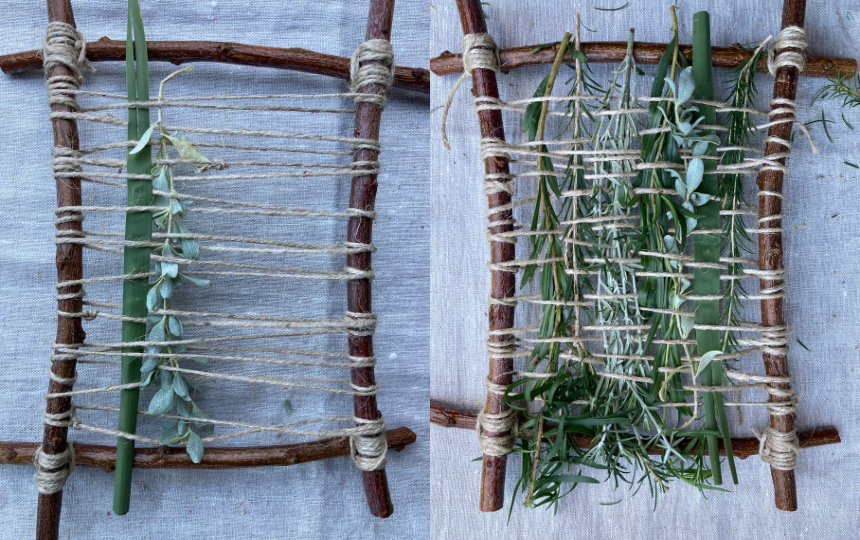
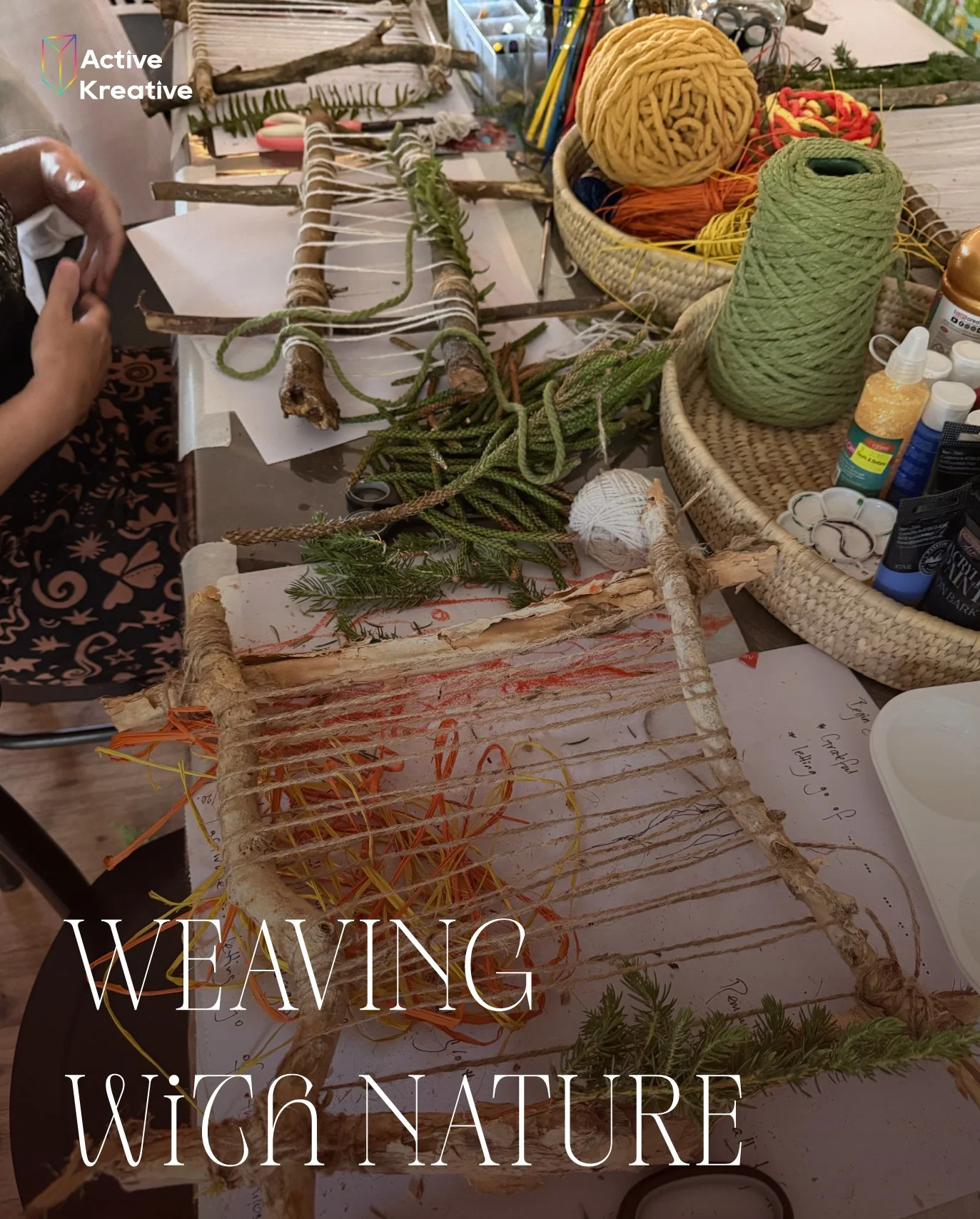
Using four sticks or branches, a frame is built — representing the Four Directions or the Medicine Wheel:
East (Air) – clarity, inspiration, breath
South (Fire) – passion, transformation, courage
West (Water) – emotion, intuition, release
North (Earth) – stability, wisdom, belonging
Each direction becomes a mirror of inner truth. The frame anchors the weaving just as core values anchor our lives.Using four natural sticks, participants build a physical frame. This becomes a sacred container — like the four directions, four seasons, four elements. It holds the space for creation and mirrors the need for inner frameworks in life.
Weaving begins from this structure. The frame symbolizes the stability we wish to anchor our lives in: personal values, roots, cultural traditions, or soul codes.
3. Activation — The Weaving Process
Threads of wool, string, or natural fiber are interlaced across the frame. Participants weave memories, emotions, and intentions into physical form. This tactile engagement with nature and rhythm evokes the flow state, described by psychologist Mihály Csíkszentmihályi as a merging of action and awareness — a sacred space where time dissolves and the self expands.
The Active Kreative approach encourages mindfulness within movement. Every knot, color, and texture becomes metaphorical — representing life’s cycles, tension, and release, the connections we make, and the patterns we repeat. Threads are woven across and within the frame, knotting stories into shape. This process often reveals unconscious beliefs, emotional undercurrents, or unspoken dreams. The tensions of the threads mimic our own internal pulls — between past and future, fear and desire, silence and expression.
As sticks bend and threads tangle, the metaphor unfolds: healing is not linear. Belonging is not perfection. It’s adaptation, grace, and creative resilience.
4. Affirmation — The Storytelling
The process culminates in storytelling and reflection. Each creation is shared within the group or silently contemplated. The act of witnessing transforms art into meaning. The story behind the weaving often reveals subconscious truths — about identity, ancestry, or healing themes ready for integration. Each piece becomes a mirror — not just of the individual, but of collective healing. In group settings, participants are invited to witness one another’s weavings in sacred silence or with shared words. The witnessing completes the ritual: “I see you. I see myself in you.”
This final stage aligns with the Affirmation phase of the Active Kreative framework, where participants honor what has been created and affirm new intentions for their path forward
The Four Directions and the Medicine Wheel: Mapping the Psyche
In many Indigenous traditions across the world, the Medicine Wheel symbolizes balance and wholeness — an ancient map of the human psyche and its relationship to nature. It teaches that healing happens not through isolation but through harmony between all directions: mind, body, spirit, and emotion.
In Nature-Weaving Therapy, the Medicine Wheel becomes both literal and symbolic. The four sticks forming the weaving frame align with the wheel’s quadrants, allowing participants to explore how their life currently reflects or resists balance. As they weave across these axes, they integrate opposing forces — masculine and feminine, inner and outer, creation and rest.
This cyclical awareness is further deepened by reflection on the cycles of life — the ever-turning rhythm of birth, growth, decay, and renewal. By embodying these cycles through creative ritual, participants come to see their own lives not as linear struggles but as part of an ongoing spiral of transformation.
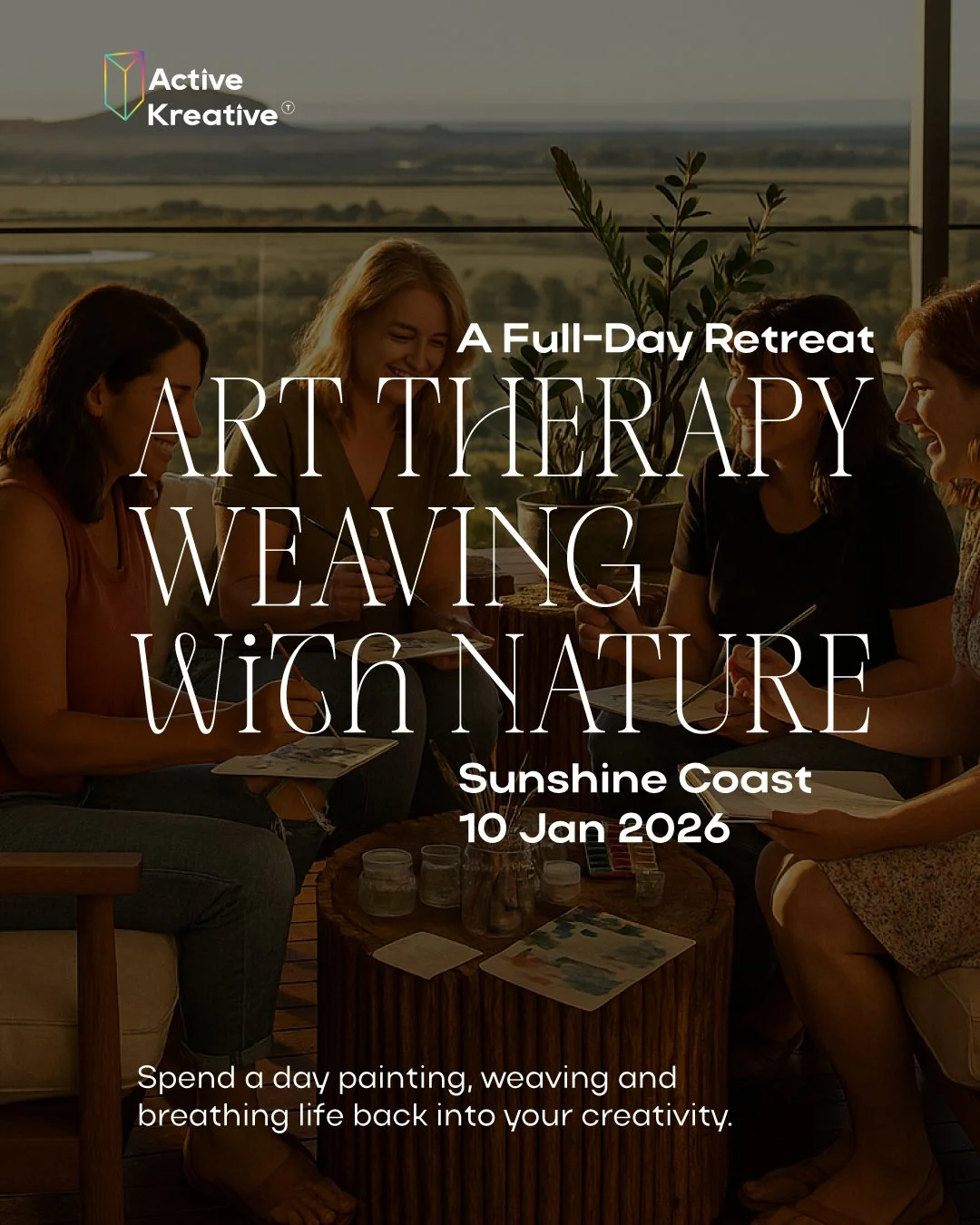
Saturday, 10 January 2026 • 11:00 am – 5:00 pm
426–436 Valdora Road, Valdora QLD 4561
(Easy access • Parking on-site • Uber-friendly)
A one-day sanctuary for creative healing, embodied rest, and emotional renewal.
Here, we move beyond perfectionism and performance. We paint what we feel. We breathe through what we’ve been holding. We release, rewrite and return home to the vessel that carries our light.
Held in nature’s embrace, we’ll co-create a body mandala on the earth, closing with a fire offering — a ritual of clearing and remembrance.
A day to realign, remember, and reimagine yourself as art in motion.
✧ Date: Sunday, 10 January 2026
✧ Time: 11 am – 5 pm
✧ Location: Valdora, Sunshine Coast
✧ Spaces: Limited to 15 participants
Includes all materials, lunch, tea and snacks.
The Cultural and Ancestral Threads
Cultural anthropology reminds us that weaving has always been more than craft — it’s storytelling through structure. From Aboriginal dilly bags to Navajo rugs and Peruvian tapestries, weaving preserves collective memory and cosmology.
Ancestral traditions recognized weaving as a dialogue between humans and the unseen world. Every fiber carried an energy — prayers, songs, and intentions woven into physical form. In Celtic lore, Brigid, the goddess of creativity and healing, was invoked through woven crosses. In Slavic folklore, women wove protection symbols into their fabrics. These practices bridged the material and spiritual worlds — uniting what we see and what we sense.
Nature-Weaving Therapy honors this lineage by allowing modern participants to reclaim ancestral wisdom in a contemporary, therapeutic context. Through creative ritual, they reconnect with forgotten traditions, bridging ancient memory and modern mindfulness.
Threads That Connect: Storytelling as Medicine
Each completed weaving tells a story — a tapestry of emotion, value, and discovery. Within Active Kreative’s group settings, participants share these stories as a ritual of witnessing. Listening to another’s narrative activates empathy and mirrors our shared humanity. It’s not uncommon for tears, laughter, or quiet awe to fill the room as participants realize that though each thread is unique, the pattern of healing is universal.
Storytelling serves as the bridge between art and meaning, anchoring the self-discovery process. Through metaphor and image, participants externalize what words could not hold — transforming emotional chaos into coherent visual language.
This mirrors the broader philosophy of Active Kreative: that healing is not about fixing, but about remembering — remembering who we are beneath conditioning, beneath pain, beneath silence.
The Science of Weaving and the Nervous System
While the process feels mystical, it’s deeply physiological. The rhythmic, repetitive motion of weaving naturally engages the parasympathetic nervous system, signaling safety and calm. The combination of tactile stimulation, creative focus, and sensory engagement integrates both hemispheres of the brain — a principle also found in neurographic art, one of the pillars of the Active Kreative methodology.
Weaving acts as a bilateral integrator — connecting the logical left brain (pattern, structure, sequence) with the intuitive right brain (color, texture, meaning). This dual activation promotes coherence between body and mind, leading to emotional regulation and expanded awareness.
This balance is particularly restorative for individuals experiencing anxiety, trauma, or burnout, as it gently resets the nervous system while fostering a sense of agency and beauty.
Finding Materials, Finding Meaning
Part of the beauty of Nature-Weaving Therapy lies in the search for materials. The act of walking in nature — noticing what the earth offers — becomes a form of meditation. A curved stick might symbolize flexibility, a piece of driftwood resilience, a feather hope.
Gathering natural objects cultivates mindfulness, inviting participants to see the world as alive with messages. This eco-somatic practice fosters gratitude and reciprocity — principles essential to ecological healing and emotional balance.
Weaving as a Path of Self-Discovery
At its core, Nature-Weaving Therapy is a journey of self-discovery. Through the weaving process, participants uncover inner patterns, values, and emotional truths. The physical threads become metaphors for life threads — relationships, memories, and personal boundaries.
As one weaves, one begins to ask:
What am I holding onto too tightly?
Where do I need more space or flow?
Which threads of my life need repair, and which can be released?
In this sacred space, art becomes therapy, and therapy becomes art — not through analysis, but through embodied awareness.
Beyond personal therapy, Nature Weaving also becomes a form of ecological and social healing. In a world that often feels fragmented and disconnected, the act of weaving rethreads the bonds between people, place, and community. It calls us to slow down, to collaborate with the Earth and each other.
In group settings, each person’s weaving becomes a thread in a larger collective tapestry — a living artwork that symbolizes connection and shared stewardship. Through communal making, we remember that we belong not only to ourselves, but to each other and to the land that holds us.
Ethical Relationship to Materials and Seasons
An essential part of this practice is cultivating an ethical relationship with materials. We gather thoughtfully — taking only what is offered, what has already fallen, or what the Earth can spare. This mindful approach honors the rhythms of the land and the cycles of the seasons.
Many practitioners choose to let their weavings remain outdoors — allowing wind, sun, and rain to slowly transform them. In doing so, the artwork becomes ephemeral, dissolving back into the Earth and completing its cycle. This impermanence reminds us that beauty need not be preserved to be meaningful; its purpose is to awaken presence, gratitude, and reverence.
Saturday, 10 January 2026 • 11:00 am – 5:00 pm
426–436 Valdora Road, Valdora QLD 4561
(Easy access • Parking on-site • Uber-friendly)
A one-day sanctuary for creative healing, embodied rest, and emotional renewal.
Here, we move beyond perfectionism and performance. We paint what we feel. We breathe through what we’ve been holding. We release, rewrite and return home to the vessel that carries our light.
Held in nature’s embrace, we’ll co-create a body mandala on the earth, closing with a fire offering — a ritual of clearing and remembrance.
A day to realign, remember, and reimagine yourself as art in motion.
✧ Date: Sunday, 10 January 2026
✧ Time: 11 am – 5 pm
✧ Location: Valdora, Sunshine Coast
✧ Spaces: Limited to 15 participants
Includes all materials, lunch, tea and snacks.
Here, we move beyond perfectionism and performance. We paint what we feel. We breathe through what we’ve been holding. We release, rewrite and return home to the vessel that carries our light.
Held in nature’s embrace, we’ll co-create a body mandala on the earth, closing with a fire offering — a ritual of clearing and remembrance.
A day to realign, remember, and reimagine yourself as art in motion.
✧ Spaces: Limited to 15 participants
Includes all materials, tea and snacks.
The Circle Returns: Integration Through the Active Kreative Community
Every Nature-Weaving session ends as it begins — in circle. Participants share reflections, insights, and gratitude, closing the process with collective resonance. These circles echo the Medicine Wheel, reminding us that healing is communal and cyclical.
Through programs like The Creative Circle and Online Courses Active Kreative continues to offer these transformative spaces — blending ancestral wisdom with contemporary psychology, nature-based therapy, and sacred creativity.
Each circle, each weave, each thread becomes part of a greater tapestry — the living art of collective healing.
Conclusion: Reclaiming Wholeness Through the Weave of Life
Nature-Weaving Therapy is more than a creative practice; it’s a way of remembering our place in the greater web of life. It teaches that every thread matters — that our emotions, stories, and values are interwoven with the natural world.
Through Active Kreative’s holistic framework, weaving becomes a living metaphor for integration — aligning the four directions of the self, restoring nervous system balance, and reawakening the ancient connection between art, nature, and spirit.
In the end, each weave whispers the same truth:
We are all threads in the same tapestry — connected, resilient, and beautifully unfinished.