Sacred Geometry as Embodied Pattern
Sacred Geometry as Embodied Pattern
By Valeriya Ogorodnyk · Transpersonal Art Therapist · Active Kreative, Melbourne · 18 min read
A grounded, soulful guide to sacred geometry as a therapeutic language for the body, psyche and field — and how circle, spiral and breath can return us to coherence.
We are not broken. We are geometric.
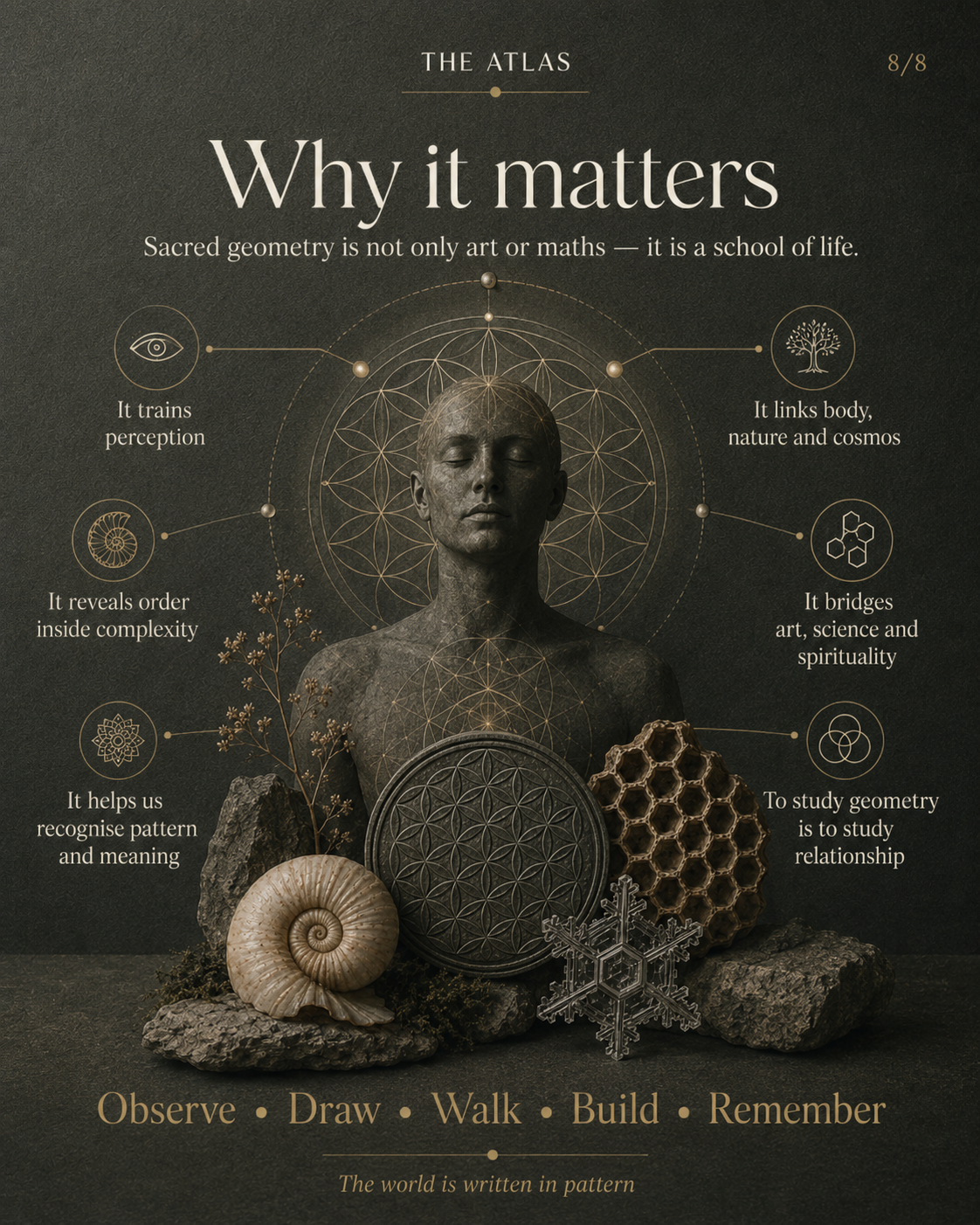
Sacred geometry can be written about in two very different ways. One treats it as an esoteric system of hidden truths. The other treats it as disciplined pattern — circles, symmetries, intervals, crossings, centres and spirals that organise attention, movement and meaning. At Active Kreative, we work primarily in the second register, without dismissing the spiritual language of remembrance and activation. We simply ask: what do these experiences look like in practice, in the body, in therapeutic work?
Read this way, sacred geometry is not mystical decoration. It is a structured visual field that can be engaged before explanation. Repetition stabilises attention. Symmetry provides a reliable map. Slow drawing recruits breath, rhythm and sensory focus. Image-making gives the psyche a non-verbal surface on which feeling, memory and symbol can emerge.
“We aren’t broken. We are geometric.”
That sentence shifts the frame. In therapeutic terms, it moves us away from shame and toward pattern recognition. Distress is no longer proof of defect — it is evidence of organisation under pressure. The nervous system structures itself around survival, narrows under threat, then widens again when it can recognise pattern and recover choice. Sacred geometry, used as a creative therapy, becomes a compassionate technology of attention.
What sacred geometry actually means
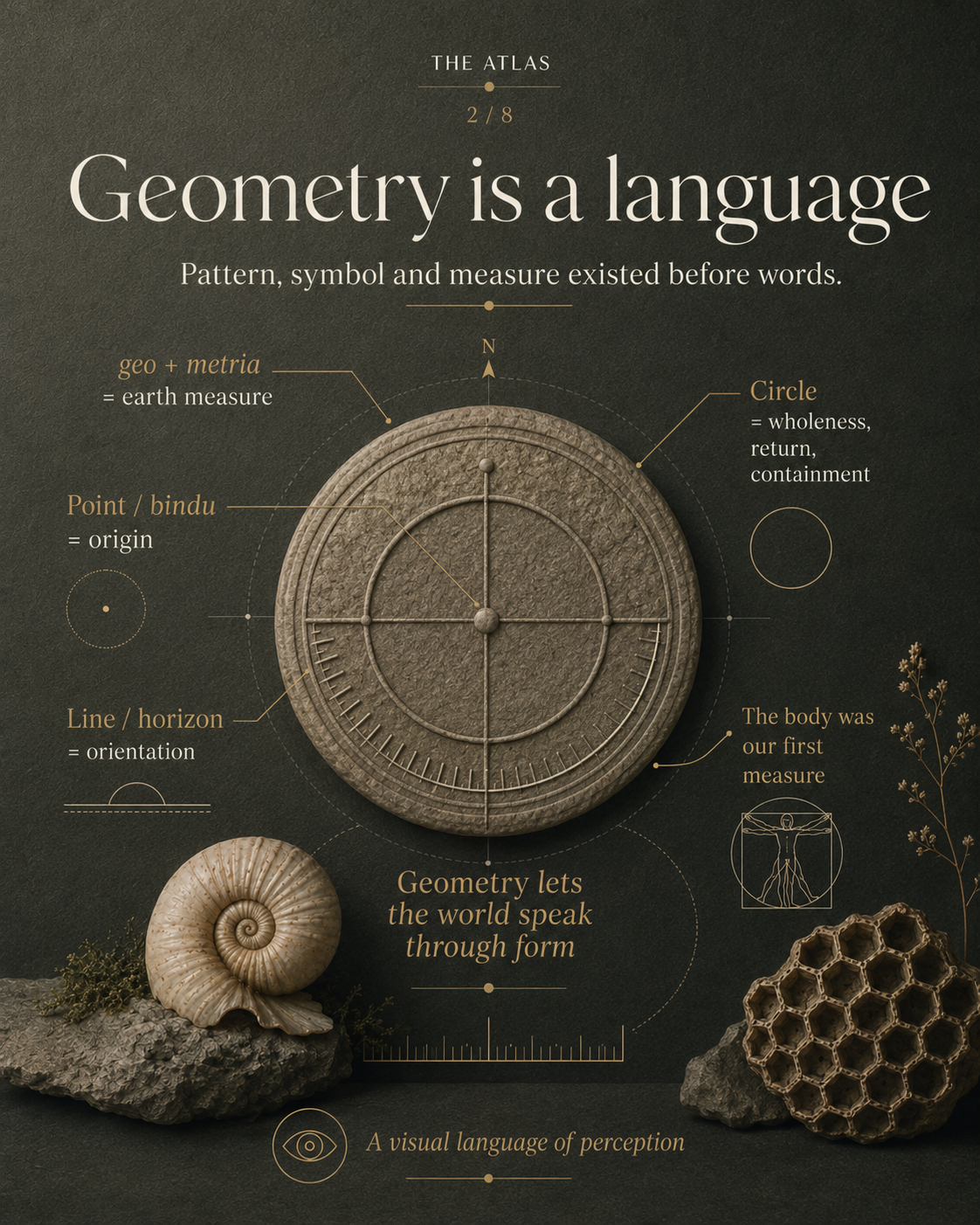
The word itself is instructive. Sacred comes from the Latin sacer — that which is set apart, devoted, worthy of reverence. Geometry comes from the Greek gē (earth, world) and metra (to measure). And the etymology of metra — metric, meter — is also the root of mother, matter and material. In Sanskrit there is no exact word for meter; the closest derivation is from maya, meaning illusion or imagination. So sacred geometry is, quite literally, a sacred measuring of the world — and the world it measures is made of mother, matter and image. Figuring it out is a measuring of the world.
This matters for practice. Long before geometry meant calculation, it meant the act of taking the body into the landscape and finding proportion. The Royal Cubit — the embodied unit of measure used to build ancient temples and cathedrals — was the length from elbow to fingertip. When we walk into Westminster Abbey or Borobudur or Chartres, the resonance we feel before any explanation is partly because these spaces were measured through human bodies, not abstract numbers. Proportion was scaled to the breath, the spine, the stride. That is why holistic wellness traditions across cultures speak the same vocabulary: the bindu (point, circle), the nadis (channels, horizon, currents), and the prana (breath, the patterning of water and air). Geometry, language, body, and breath are not separate.
Sacred geometry as a language before words
Geometry is not a subject — it is a language. That distinction matters. If geometry is a subject, the participant asks: Am I precise enough? Mathematical enough? Artistic enough? If geometry is a language, the participant is invited into relationship: with line, shape, interval, centre and repetition. There is nothing to perform. There is only something to feel.
The body responds to the emotional environment long before we have language for it. Care, contact, stress and safety shape the nervous system in early life, before speech. This relational scaffolding — an architecture of adaptation — teaches us when to soften, defend, attach, withdraw or over-function. In a creative exploration session, sacred geometry meets this preverbal layer of self directly. The compass moves before the mind does.
This is why an Active Kreative workshop begins not with metaphysics but with a container. You find the centre of the page. You draw one circle. That first circle becomes your world, your container, your safety field. The Seed of Life unfolds from there — not as a doctrine to decode, but as a progressive unfolding: self, boundary, expansion, relation, interconnectedness.
The Active Kreative Process — four stages
Every sacred geometry session — whether a single workshop or a full 40-Day Practice — moves through the same four stages. Each one mirrors what the body needs in order to feel safe enough to expand.
- Initiation — safety, threshold, arrival in the body
- Creation — patterned action: circle, line, breath
- Activation — meaning emerges from the image
- Affirmation — integration through colour and presence
Pythagoras’ Tetractys — the trajectory of the soul into matter
Long before Pythagoras was a name in a textbook, he was an initiate of a school in which geometry, music and ethics were one discipline. The form he held most sacred was the Tetractys: ten points arranged in a triangle of four rows — one, two, three, four. Pythagoras believed this single drawing contained everything a soul needs to know about its descent into matter and its remembering of return.
Look at it for a moment. The first row is a single point — pure beginning, the bindu, undivided. The second row is two points — the first relationship, the first line. The third row gives the triangle, the first enclosed plane. The fourth row of four points is the base of the tetrahedron, the first volume. Point, line, plane, volume. The soul descends into form.
What most people do not notice on first sight is that the Tetractys quietly contains Pascal’s triangle. Read the rows as numbers and the same triangular arrangement gives the binomial coefficients that govern probability, combinatorics and natural growth. Sum the shallow diagonals and you get the Fibonacci sequence — one, one, two, three, five, eight, thirteen, twenty-one — the same proportions that govern the golden ratio, the spiral of a nautilus shell, the curl of a fern, the unfurling of a sunflower head.
This is not a Western secret. The same pattern is known in India as the staircase to Mount Meru, in Persia as the Khayyam triangle, and in China as the Yang Hui triangle. It has been studied for more than 2,500 years by mathematicians across cultures, propagated in Indian Sanskrit poetry centuries before Pascal wrote about it in Europe.
Drawn as a fractal, the Tetractys becomes the Sierpinski triangle. Built out of sticks in three dimensions, the same logic gives the tetrahedron, the icosahedron, the Star of David, the octahedron — what alchemists called the majestical polyhedra. In an Active Kreative class, this is the moment when participants understand viscerally that geometry, number, music and matter are not different subjects. They are different costumes for the same underlying pattern.
The art of process — why drawing matters
There are beautiful books on this material — The Theology of Arithmetic translated by Robin Waterfield, with a foreword by Keith Critchlow, and Pascal’s Arithmetical Triangle. They are phenomenal. They are also written almost entirely in words, fractions and computer-generated diagrams. They show you what the patterns look like once finished. They rarely teach you how to draw them.
This is the gap Active Kreative was built to fill. The truth lives in the process. When the hand draws the Seed of Life slowly — when the compass returns to the circumference, when the wrist remembers the radius, when the eye begins to anticipate where the next intersection will fall — something happens that no diagram in a book can transmit. The image becomes a felt knowing rather than an intellectual concept.
This is the difference between reading about water and learning to swim. It is also the difference between a sacred geometry workshop in Melbourne and a video about sacred geometry. The former teaches your body. The latter teaches your mind. Both have value — but only one of them re-patterns the nervous system.
How sacred geometry regulates attention, body and perception
The strongest claim we can make rigorously is not that sacred geometry is a supernatural technology. It is that structured geometric practice combines several mechanisms already known to matter in nervous system regulation and mental life. Seven of them, woven together, form the spine of an Active Kreative session.
1. Coherence — from fragmentation to steadiness
When the page offers a centre, repeated intervals and visible order, you receive a stable map. Pattern reduces arbitrariness. A predictable task can interrupt spiralling interpretive noise and create enough steadiness for reflection to begin.
2. Attention training
Focused-attention research shows that directing and returning attention to a chosen object recruits attention-related neural systems and can alter broader brain-network organisation.[1] Sacred geometry does this in a visual-motor register: centre the compass, trace the arc, align the edge, repeat the circle, return to the point of intersection. The page becomes an attentional anchor.
3. Non-verbal meaning-making
“I don’t know why, but this is important.” That is not a failure of the method — it is the method. Jung described this as circumambulation: staying close to an image, circling it from different angles, rather than reducing it to explanation. There is no strictly linear evolution of the self, Jung wrote — only circumambulation of a centre.[2]
4. Predictability and repetition
Repetition gives the nervous system a safer job than improvising under uncertainty. The hand repeats what the eye can anticipate. The breath settles into the tempo of the marks. This is the somatic ground beneath every neurographic art and sacred geometry practice.
5. Bilateral, rhythmic drawing
When the hand alternates directions, repeats mirrored actions or traces balanced arcs, the page becomes not only symbolic but rhythmic. Expressive-arts and neuroscience reviews consistently point to active sensorimotor engagement as central to how the arts affect wellbeing.[3]
6. Symbolic emergence
Once you settle into making, the image becomes a projection surface. The pivot question is crucial: instead of asking what is wrong, ask what structure in me is reacting right now? Geometry holds the inquiry without requiring immediate confession or narrative disclosure.
7. Perceptual shifting
Sustained pattern practice trains pattern detection. After drawing circles, vesicas, mandalas or spirals, you begin to notice geometry in leaves, windows, floor tiles, ceilings — and in relationships. Aesthetic attention changes how stimuli become salient.[4]
Geometry across nature, architecture, music and art
If sacred geometry is to be more than a studio exercise, it helps to see where patterned form already appears in the world. The same vocabulary that organises a Seed of Life on paper organises a sunflower head, a cathedral dome, a snowflake, a melody.
In nature
Look closely and the body itself is geometric. Skin is built of tiny triangles. The human form, arms and legs outstretched, fits the proportions of a pentagon — a five-pointed star. The molecule we are made mostly of — water — is hexagonal. The central nervous system, stretched out, is approximately 73 miles long and looks — in its branching chaos — remarkably like mycelium beneath the soil.
The pattern continues outward. Plant phyllotaxis exhibits spiral organisation, with divergence angles approaching the golden angle of about 137.5°.[5] Equal circles pack most densely in a hexagonal lattice — the arrangement that explains honeycomb efficiency, the cowfish’s hexagonal scales, and the isometric grids of paper-wasp nests. Saturn’s north pole holds a hexagonal vortex, likely shaped by the planet’s water content; snowflakes return to six-fold symmetry regardless of humidity; salt crystals arrange as octahedrons.
The Kiss of Venus — the trajectory traced by Venus as observed from Earth across an eight-year cycle — draws a perfect pentagonal pattern in space, in proportion to human DNA. A spiderweb is a Delaunay triangulation. A gecko’s scales form the same domed tiling as the cupolas of Palermo Cathedral. Diatoms — the microscopic phytoplankton that coat the surface of every body of water — build silica frustules of breathtaking patterned beauty at the edge of sight. Hakea leaves, eucalyptus seed pods, peace lily flowers, ginger blossoms, pandanus — every walk in a garden becomes a curriculum.
In architecture
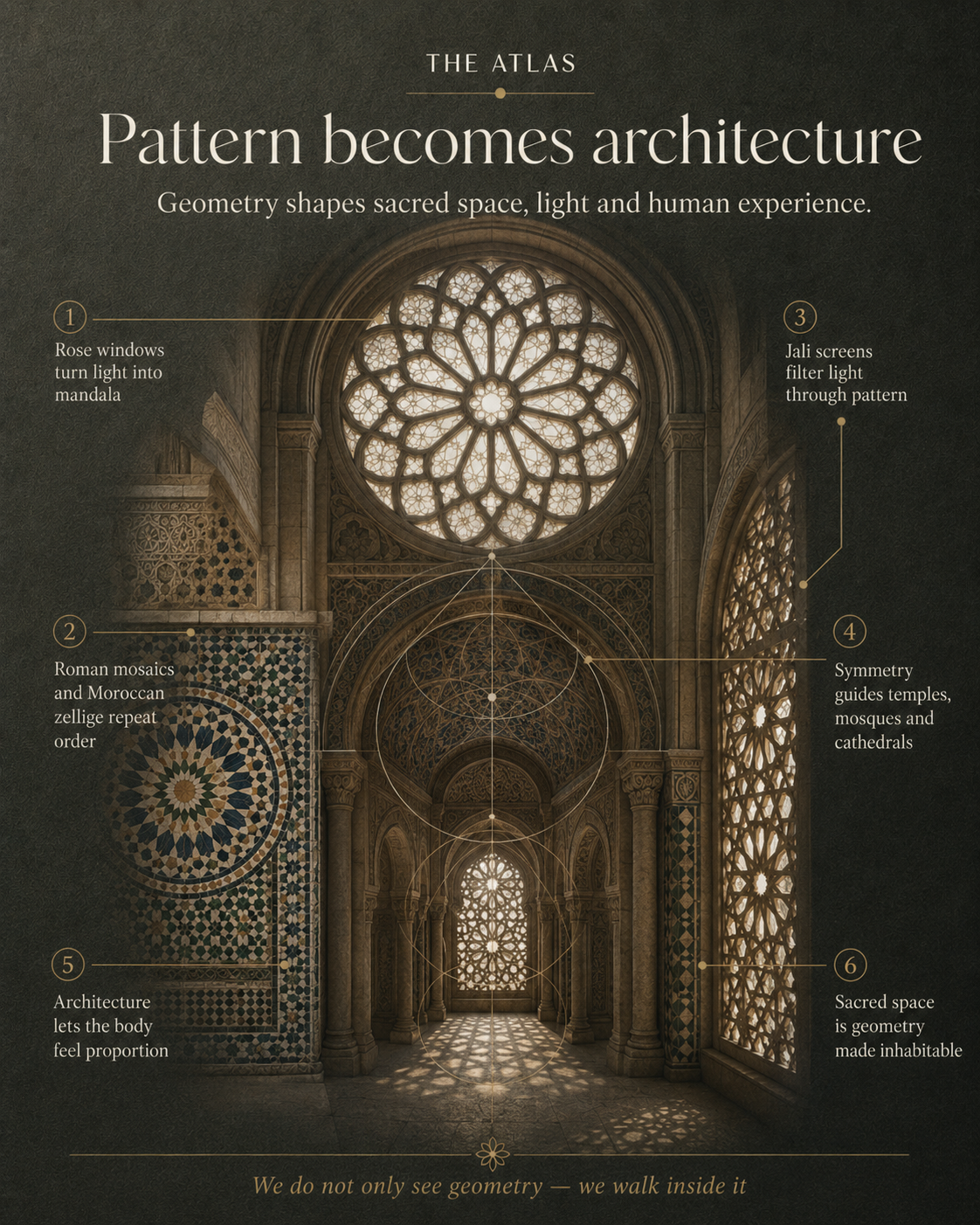
Geometry organises not only ornament but experience. UNESCO describes Borobudur as one of the greatest Buddhist monuments in the world, its mandala form repeated at the scale of the surrounding landscape.[6] Westminster Abbey’s design is based on the continental system of geometrical proportion; its rose windows are explicitly linked to symmetry and symbolic order. Islamic geometric patterns, as the Metropolitan Museum of Art documents, are not incidental embellishment but a primary decorative and conceptual element across architecture and objects.[7] Monreale Cathedral in Sicily, Fatehpur Sikri in India, the sliding dome of Masjid al-Nabawi in Saudi Arabia, the Moroccan zellige, the carved jali screens of Mughal India — all are conversations in the same language.
When a place is built through proportion, the body often feels it before the mind can explain it.
In music
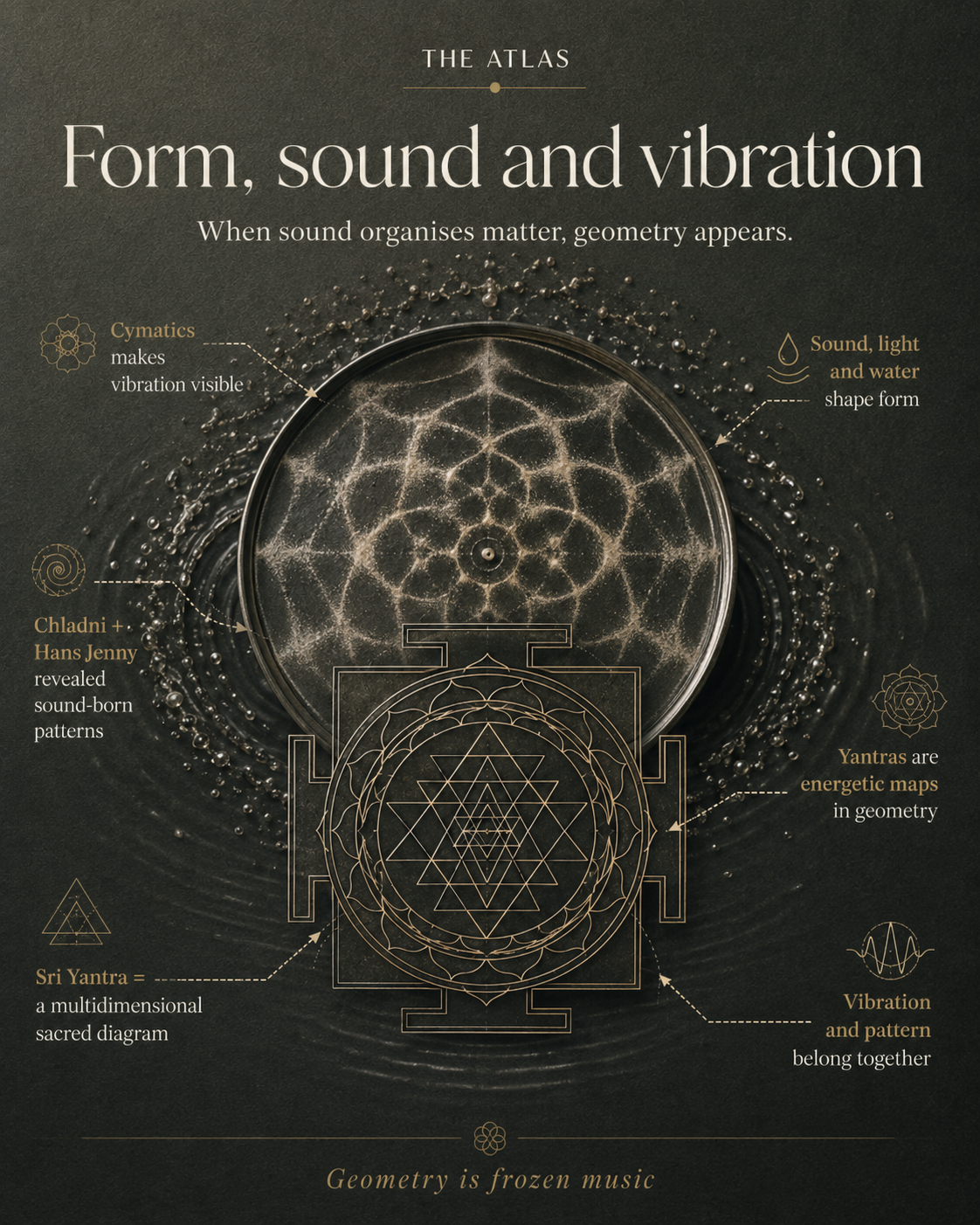
Geometry is frozen rhythm; music is moving ratio. The old quadrivium still holds: arithmetic as number in itself, geometry as number in space, music as number in time, cosmology as number in spacetime. A mandala and a melody both distribute tension, recurrence, return, variation and centre — one visually, one acoustically.
This is most visible in cymatics — the study of sound made visible. The Chladni plate (a metal plate sprinkled with sand and bowed at its edge) produces stable four-, eight-, sixteen-fold patterns determined by its square base. Hans Jenny’s experiments with water in petri dishes — sound translated through liquid and light into the cymascope — reveal the same geometries we draw on paper: heptagons, mandalic stars, lattices. Sound, geometry and water are different appearances of the same underlying order.
In art
The mandala is a particularly important bridge between contemplative tradition and therapy. Britannica defines the mandala in Hindu and Buddhist Tantrism as a symbolic diagram used in sacred rites and as an instrument of meditation.[8] Modern therapeutic mandala work is not the same as ritual Tantric practice — but both treat patterned circular form as a site of gathering, centering and orientation.
A guided practice: drawing the Seed of Life
The most clinically grounded way to begin sacred geometry is simply. The Seed of Life is ideal — it offers enough structure to regulate but not so much complexity to overwhelm. Move through it as a complete somatic art therapy sequence, following the four Active Kreative stages.
Initiation — arrive in the body
Sit with paper, a pencil, a compass or round object, a ruler, and colours if available. Before drawing anything, orient. Feel the chair, the floor, the weight of the hands. Let the gaze soften. Introduce a slower inhale and a longer exhale — gentle enough that another person may not even notice. This is not performance. This is reorientation.[1]
Creation — find the centre, draw the seed
Find the centre of the page. Mark one point. Draw one circle. Let that first circle stand for a container — boundary, world, field, safety. Then draw six equal circles around it, each new circle centred on the circumference of the first. You will arrive at seven congruent circles in a hexagonal arrangement: the Seed of Life. Mathematically, this belongs to the wider logic of circle packing.[9] Experientially, it gives the hand a repeatable pathway and the eye a growing field of relation.
Stay with three questions rather than chasing interpretations:
- Where is my centre?
- What happens to my breath when the pattern expands?
- What part of me resists repetition, and what part relaxes into it?
Activation — let the image speak
Pause when the Seed is complete. Notice whether anything in the image feels especially alive or resistant. If a particular overlap, petal or edge calls attention, stay there. Do not explain too quickly. Circle the image with attention and let meaning assemble.
Affirmation — colour as integration
Apply colour intuitively rather than symbolically. Colour is not an exam in correspondence systems — it is a way of moving the structure from outline into felt life. Insight often arrives here, during colouring, not earlier. Close with one prompt on the page: What part of me is asking to be reorganised?
Borobudur is the Sri Yantra — built in stone
One of the most extraordinary recognitions in contemporary sacred geometry study is that Borobudur — the 8th-to-9th century structure in Central Java, the largest mandala in the world — can be read as a three-dimensional Sri Yantra. The same nested geometry that defines the Sri Yantra in two dimensions — the central bindu, the nine interlocking triangles, the surrounding lotus and outer vessels — is built into Borobudur as ascending square terraces, encircling stupas, and four cardinal gates.
This is not a poetic comparison. It is a structural recognition. The Sri Yantra is the geometry of shrī — the Sanskrit word for auspiciousness, radiance, the generative source. Within the Shri Vidya tradition of Vajrayana Buddhism and tantric practice, this yantra is understood as the visual map of consciousness in its descent into and ascent from matter. Borobudur, walked in circumambulation from the outer square terraces to the central stupa, is that same map made walkable. Pilgrims have moved through it for over a thousand years without knowing the exact name of the geometry they were inhabiting.
This recognition matters for practice. It means that the same geometry we trace on a page is the geometry a body can walk. The same form holds in the breath, in a circle of women, in a 40-day arc, in a cathedral, in a stupa, in a mandala drawn slowly under lamplight. The scales differ. The pattern does not.
From the page to the room: sacred geometry in community
The therapeutic value of sacred geometry lies in how little it demands rhetorically and how much it organises experientially. For clients who are fatigued by talking, over-explaining or managing themselves socially, geometry offers a third way — not silence as shutdown, and not speech as performance, but pattern as participation.
Regulation is not only private. A person who can remain steady within pressure changes the field around them. One regulated participant changes the tone of a room. One attentive witness changes what another person can tolerate. One coherent facilitator alters the pace, safety and depth of a group.[3] This is the simplest, most honest way to read the language of collective coherence: as a relational field effect, observable in any group held with attention.
Because sacred geometry is portable, low-cost and easy to adapt across cultures, it travels well. The Ukrainian Kolo — Active Kreative’s refugee support program (2022–2026) — was built on exactly this principle. The same vocabulary that opens a private therapeutic session also holds a community circle of women navigating displacement, grief and remaking. One person experiences it as meditation. Another as design. Another as nervous-system regulation. Another as ceremonial art. That flexibility is part of its strength.
Key forms of sacred geometry — at a glance
| Form | What it is | Therapeutic resonance |
|---|---|---|
| Circle (bindu) | Single closed curve, equidistant from a centre | Container, boundary, return to self |
| Vesica Piscis | Symmetric overlap of two equal circles[10] | Meeting, relationship, threshold between |
| Tetractys | Ten points in four rows; contains Pascal’s triangle and Fibonacci | The soul’s descent into form; point, line, plane, volume |
| Seed of Life | Seven congruent circles in hexagonal arrangement | Container expanding into relation |
| Flower of Life | Continued overlap into a wider lattice of circles | Interconnection, field of belonging |
| Mandala | Circular symbolic diagram used as instrument of meditation[8] | Gathering, centering, orientation |
| Sri Yantra | Nine interlocking triangles around a central bindu | The geometry of shrī — source, auspiciousness, radiance |
| Spiral | Curve unfolding around a centre at constant ratio (Fibonacci / golden / Archimedean) | Growth, return at a new level, integration |
| Hexagon | Six-fold symmetry; densest equal-circle packing; water, snow, honeycomb | Structural efficiency, communal weave |
| Platonic Solids | The five regular three-dimensional polyhedra (tetrahedron, cube, octahedron, dodecahedron, icosahedron) | Elemental form, embodied dimensionality |
What sacred geometry is — and isn’t
A few clarities are worth keeping visible. First, there is limited direct clinical research on sacred geometry as a distinct intervention; most evidence is indirect, drawn from art therapy, attention research, contemplative practice, aesthetic experience and pattern perception.[11] Second, historical claims about one universal sacred-geometric doctrine across all civilisations are often overstated; it is more honest to discuss recurring patterned forms across traditions than to impose a single timeless system. Third, spiritual and symbolic terms are best held as the teaching’s own vocabulary, not as verified scientific frameworks.
This honesty is not a retreat from the work. It is what allows the work to be trusted. Sacred geometry changes life not because the participant must believe in hidden cosmic coding, but because pattern can become a compassionate technology of attention. A circle can become a boundary. Repetition can become regulation. Image can become language. Colour can become integration.
Frequently asked questions
What is sacred geometry, in plain language?
Sacred geometry is the study and practice of patterned forms — circles, symmetries, spirals, hexagons, triangles — that recur across nature, architecture, contemplative traditions and the human body. The Greek roots gē (earth, world) and metra (to measure) literally describe it as a measuring of the world. At Active Kreative in Melbourne it is used as a therapeutic language: a way of organising attention, breath and image so the nervous system can settle and meaning can emerge non-verbally.
What is the Pythagoras Tetractys and why does it matter?
The Tetractys is a triangular arrangement of ten points in four rows (1, 2, 3, 4) attributed to Pythagoras as the trajectory of the soul into matter. It contains Pascal’s triangle, the Fibonacci sequence and the golden ratio, and when extended into three dimensions it gives rise to the tetrahedron, the Sierpinski triangle and the Star of David. The same pattern appears across cultures as the staircase to Mount Meru in India, the Khayyam triangle in Persia and the Yang Hui triangle in China.
How does sacred geometry support nervous system regulation?
Through several mechanisms working together: predictable pattern reduces interpretive noise; focused attention training stabilises the attentional field; bilateral rhythmic drawing engages the sensorimotor system; slow breath paired with repetition signals safety; and symbolic emergence allows meaning to condense around the image without forcing narrative. None of these is unique to sacred geometry, but the form holds them together in one accessible, soulful somatic art therapy practice.
What is the Seed of Life and how do I draw it?
The Seed of Life is seven congruent circles arranged in hexagonal symmetry — one centre circle and six around it. To draw it: mark a point, draw a circle, then place six more circles of the same radius, each centred on the circumference of the first. The result is a hexagonal flower with a clear centre — both a geometric exercise and an experiential map of container, boundary and relation.
Is sacred geometry the same as art therapy?
No, but they overlap. Art therapy is a broader clinical discipline using image-making for psychological insight and regulation. Sacred geometry, as practised at Active Kreative in Melbourne, is one specific creative therapy modality — a structured, symbol-rich, transpersonal approach that sits within the wider field of creative and somatic art therapy.
What is the Active Kreative 40-Day Practice?
The 40-Day Practice is Active Kreative’s signature container — a forty-day guided journey through sacred geometry, breath and reflective inquiry. Forty days is long enough for the nervous system to register the new pattern as embodied rather than novel. It moves through the four Active Kreative stages — Initiation, Creation, Activation, Affirmation — in a spiral, deepening with each cycle.
Do I need to be artistic to begin?
No. Sacred geometry is a language, not a subject — there is nothing to perform. If you can hold a pencil and breathe, you can begin. The compass does most of the work; your body does the rest.
Is Borobudur connected to the Sri Yantra?
Yes. Borobudur — the largest mandala in the world, an 8th to 9th century structure in Central Java, Indonesia — can be read as a three-dimensional Sri Yantra. The same nested geometry of bindu, triangles and outer vessels that defines Sri Yantra in two dimensions is built into Borobudur as ascending terraces, stupas and gates.
Where can I attend a sacred geometry workshop in Melbourne?
Active Kreative offers sacred geometry workshops, term programs and one-to-one creative exploration sessions in Melbourne. Single sessions are available; the full term journey — culminating in the 40-Day Practice — is where the deepest work happens. Begin in the free portal to feel the space first.
About the author
Valeriya Ogorodnyk — founder of Active Kreative — is a Transpersonal Art Therapist (Advanced Diploma, CCM 10701NAT, AQF 6) working at the meeting place of sacred geometry, somatic art therapy and holistic wellness. Val holds circles for individuals and communities across Melbourne, including the Ukrainian Kolo refugee program (2022–2026).
References & further reading
- Neurophysiological mechanisms of focused attention meditation. pmc.ncbi.nlm.nih.gov/articles/PMC12327082
- Jung Lexicon — entry on circumambulation and individuation. jungpage.org/learn/jung-lexicon
- How the arts heal: a review of the neural mechanisms behind art-based therapy. pmc.ncbi.nlm.nih.gov/articles/PMC11480958
- Art and Perception: Using Empirical Aesthetics in Research on Aesthetic Experience. pmc.ncbi.nlm.nih.gov/articles/PMC9222703
- An Ode to Diatoms — NOAA Fisheries on patterned form in marine microorganisms. fisheries.noaa.gov/science-blog/ode-diatoms
- Borobudur Temple Compounds — UNESCO World Heritage. whc.unesco.org/en/list/592
- Geometric Patterns in Islamic Art — The Metropolitan Museum of Art, Heilbrunn Timeline. metmuseum.org/toah/hd/geom/hd_geom.htm
- Mandala — Britannica: definition, history, types, meaning. britannica.com/topic/mandala-diagram
- Circle Packing — Wolfram MathWorld. mathworld.wolfram.com/CirclePacking.html
- Vesica Piscis — Wolfram MathWorld. mathworld.wolfram.com/VesicaPiscis.html
- Westminster Abbey — geometrical proportion and rose windows. westminster-abbey.org
- Waterfield, R. (trans.) & Critchlow, K. (foreword). The Theology of Arithmetic. Phanes Press.
- Edwards, A. W. F. Pascal’s Arithmetical Triangle: The Story of a Mathematical Idea. Johns Hopkins University Press.
- Doczi, G. The Power of Limits: Proportional Harmonies in Nature, Art & Architecture. Shambhala.
- Myers, T. Anatomy Trains: Myofascial Meridians for Manual and Movement Therapists. Elsevier.
- Jenny, H. Cymatics: A Study of Wave Phenomena and Vibration. Macromedia Press.