We Are Not Broken: Kintsugi — the Art of Becoming
There is a story most of us have been living inside without realising it. It goes like this: I was whole. Something broke me. Now I must work to become whole again. It sounds, on the surface, like healing. But underneath it runs a quiet wound of its own — the belief that the broken state is the problem, that the crack is the deviation, that the self we are becoming through difficulty is somehow lesser than the self we were before it. Kintsugi — the ancient Japanese art of repairing broken ceramics with gold — offers something far more radical than comfort. It offers a completely different story. And for those doing genuine inner work, that story can change everything. There are seasons in life when the old shape of us no longer holds. A relationship ends. Motherhood becomes heavier than language can carry. Grief stays in the body long after the event is over. A person keeps functioning, working, caring, performing, but beneath the surface something has already cracked. Not dramatically. Quietly. Internally. Persistently.
This is where kintsugi art becomes more than an aesthetic. It becomes a profound human metaphor.
It is a story of loss, recovery, and return. And it sounds, on the surface, like healing. But underneath it runs a quiet wound of its own — the belief that the broken state is the problem, that the crack is the deviation, that the self we are becoming through difficulty is somehow lesser than the self we were before it.
The Old Story Is Not the True Story
We live in a culture that treats rupture as failure.
Grief is something to move through quickly. Burnout is a problem to be solved. The ending of a relationship, a career, a version of the self — these are spoken about in the language of damage. We use words like broken, falling apart, not coping. We set recovery as the goal. We measure progress by how closely the healed self resembles the self before the wound.
But what if that measurement is the very thing preventing us from becoming who we are meant to be?
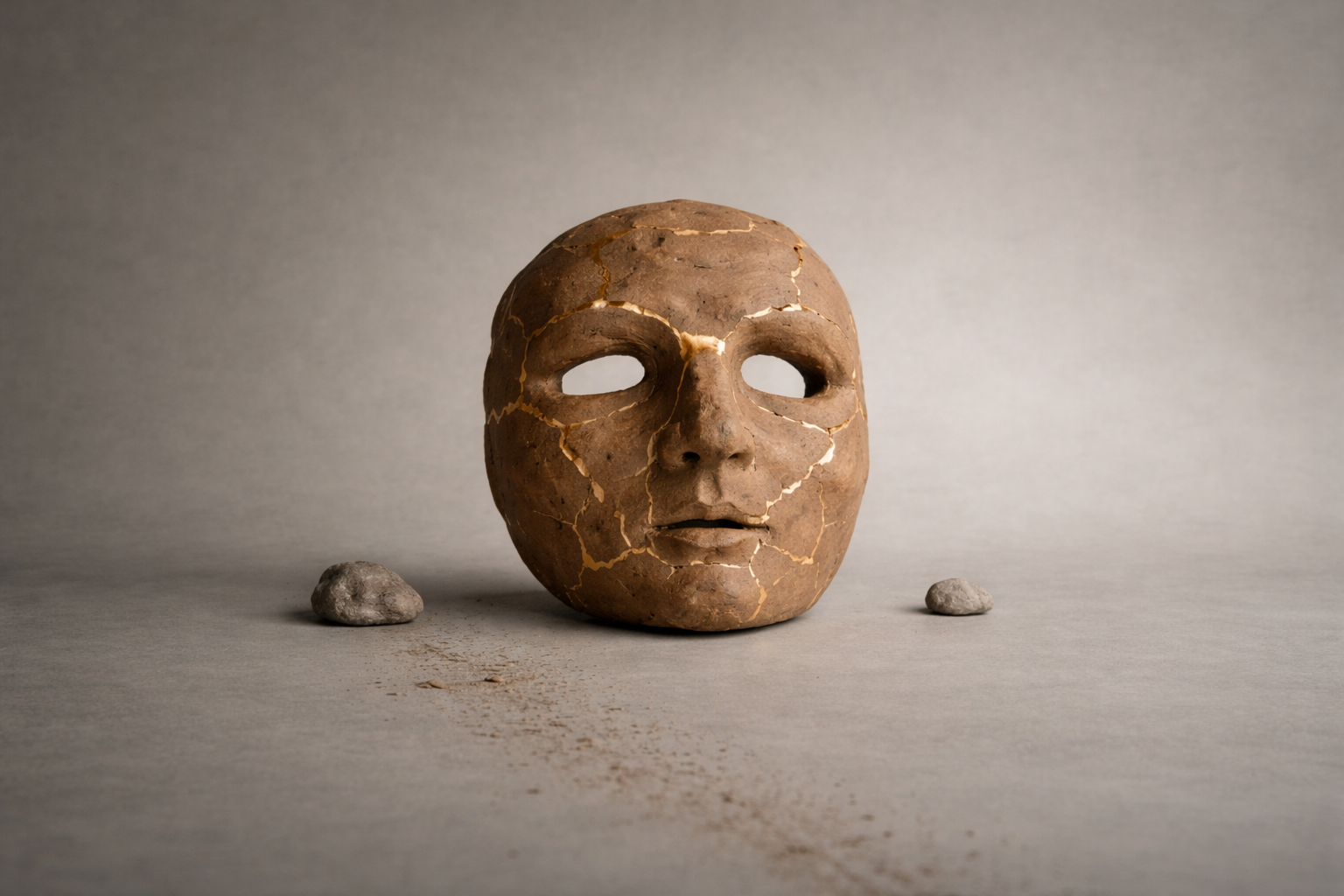
Kintsugi says something ancient and precise about this. The cracked ceramic, repaired with lacquer and powdered gold, does not return to its original form. It cannot. The break has happened. The history is real. But rather than concealing that history, kintsugi makes it visible — fills it with something luminous — so that the object becomes more itself, not less. More truthful. More complex. More beautiful because of, not in spite of, what it has carried.
The crack is not hidden. The crack is illuminated.
This is not a metaphor for resilience in the conventional sense. It is something deeper: a transpersonal reframe of what rupture is, what repair means, and what the self actually is across the arc of a life.
The Transpersonal View: Life as a Story of Becoming
Transpersonal psychology expands the lens of healing beyond the personal psyche — beyond the ego, beyond individual biography — into the wider territory of meaning, myth, soul, and the deeper currents of human becoming.
From a transpersonal perspective, the experiences we name as breaking points are not interruptions to the story of the self. They are the story. They are the moments where the constructed self — the one built from expectation, performance, role, and learned survival — can no longer hold its shape. And that collapse, as terrifying as it is, is often the very threshold through which the truer self begins to emerge.
This is why the Hero's Journey, as described by Joseph Campbell, places the ordeal at the centre of the arc — not at the end, not as the problem to escape, but as the necessary passage. The hero does not become real by avoiding the dark. The hero becomes real by passing through it and discovering what cannot be destroyed.
Kintsugi belongs to that passage.
It is not the call to adventure. It is the moment after the fall — when the old form lies in pieces, and the question is not how do I go back? but what am I becoming?
We are not meant to return to who we were before the break. We are meant to be repaired with awareness, so the fractures become the places where light enters.
The Vessel as a Symbol of the Self
In many spiritual and mythological traditions, the vessel is one of the oldest symbols of the human soul — the container that holds life, nourishment, experience, and meaning.
A vessel can be filled and emptied. It can be carried and set down. It can be passed between hands across generations. And it can break.
When we speak of ourselves as vessels, we are speaking about a self that is not fixed — that receives, holds, releases, and is shaped by what passes through it. A vessel is not defined by its perfection. It is defined by its capacity to hold.
Kintsugi, in this light, becomes a practice of returning the vessel to its function — not by pretending the break did not happen, but by integrating it. The gold does not repair the ceramic back to its original form. It creates a new form. One that carries the memory of rupture within its structure, transformed into something that catches light.
We are the vessels that were broken by life and repaired with presence.
This is a profound reframe for anyone who has spent years trying to return to a self they once were. The self before the diagnosis. The self before the divorce. The self before the grief, the migration, the loss of identity, the years of invisible labour that left them hollow. The idea that healing means returning to that former shape is not only exhausting — it is, in a transpersonal sense, a misreading of what life is asking.
Life is not asking us to return. Life is asking us to become.
Repair as Remembering: The Deeper Practice
Here is where the practice moves beyond metaphor into something genuinely transformative.
In the Active Kreative methodology — the transpersonal creative arts framework that holds The Atlas Creative Circle — the process of healing through creative expression is understood as an act of remembering. Not the remembering of facts or events, but the remembering of self. A coming back into contact with what was always true beneath the performances, the protections, the survival strategies, the accumulated weight.
This is why the kintsugi process, as a workshop modality, works so differently from verbal processing alone. It does not ask the participant to explain their wound. It does not require a coherent narrative. It invites the person into relationship with image, material, sensation, and symbol — and in that relationship, something that could not be spoken begins to take form.
The gold line drawn across the fracture in the artwork is not decoration. It is an act of witness. It says: this happened. I am not hiding it. I am bringing it into the light.
For many people, this is the first time a wound has been treated not as something to overcome, but as something to integrate — to carry forward, visible, honoured, transformed.
Like kintsugi, healing does not erase rupture. It integrates it. The self becomes more coherent not by avoiding breakage, but by consciously restoring what was fractured.
The Shadow and the Gold: A Jungian Meeting
Carl Jung described the shadow as the repository of everything the self has rejected, suppressed, or not yet owned — the parts of us deemed too much, too dark, too vulnerable, too raw for the world we learned to navigate.
In kintsugi terms, the shadow is what lives along the fracture line.
It is the grief that was never permitted to land. The anger that was redirected into responsibility. The longing that was edited out before it could be spoken. The parts of the self that cracked under pressure and were quietly sealed over rather than repaired.
The gold of kintsugi — in this deeper reading — is consciousness. It is the choice to bring awareness to what has been hidden. To look honestly at the break rather than polishing over it. To ask not what is wrong with me? but what has been waiting here to be witnessed?
This is the transpersonal invitation at the heart of Broken Open: not to perform healing, but to cross an inner threshold. To meet the fracture with presence rather than avoidance. To discover that the shadow, brought into relationship with light and awareness, is not the enemy of wholeness — it is a portal into a truer version of it.
The wound, witnessed fully, becomes a teacher.
What the Gold Actually Means
In a world saturated with wellness content and healing aesthetics, it is worth being precise about what kintsugi is genuinely offering.
The gold is not a promise that everything will be beautiful after pain. It is not spiritual bypassing — the practice of rushing toward the light to avoid the dark. It is something more honest and more demanding than that.
The gold means: I was here. This happened. I did not look away. The gold means the repair is real — not cosmetic, not performed, not achieved by returning to a former self, but forged in the actual material of the experience. It means the fracture is now part of the structure, not despite the repair, but through it.
This is what makes kintsugi such a precise metaphor for the transpersonal journey. Not transformation as escape. Transformation as integration. Not a new self built on top of the old wound. A truer self, built from honest relationship with it.
We are not broken. We are repaired into truth.
The Invitation
If you have been carrying a fracture quietly — grief, rupture, resentment, shame, an old self that no longer fits — this is for you.
Not to fix you. Not to return you to who you were. But to offer a space where the break can be met with presence, where the wound can be witnessed without performance, and where the gold can be laid along the line of what was lost.
You are not broken. You are a vessel shaped by everything you have carried — and everything you are still becoming.
The crack is not failure. The crack is where the light enters. And the repair — honest, visible, luminous — is the most truthful thing you will ever make.
Why art can help where talking reaches a limit
One of the reasons kintsugi art workshopscan feel unexpectedly deep is that they bypass the pressure to explain oneself perfectly.
Art therapy research with adults has found evidence of improvement across emotional domains, including trauma symptoms, depression, anxiety, and stress-related concerns, while also noting that the field is complex and studies vary in method. A 2024 study on Trauma-Focused Art Therapy found clinically significant reduction in PTSD symptoms in the case studied, along with reduced depression and improved emotional articulation, resilience, self-esteem, and positive mental health.
That does not mean every art workshop is therapy, or that creative practice replaces clinical care. It means that image-making, symbolism, sensory engagement, and embodied reflection can support emotional processing in ways that many people find more tolerable and more truthful than immediate verbal disclosure.
This is especially relevant for people who are “emotionally full but finding words inadequate,” which is exactly how the Atlas field describes many of the people who enter it.
What participants gain in Broken Open
The visible artwork is only part of the outcome.
A participant may leave with a collage or kintsugi-inspired image marked in gold, but what often matters more is the internal shift: a movement from “something is wrong with me” to “something in me has been carrying too much, and now it can be witnessed.”
The Atlas guide names several likely discoveries from this session: identifying one wound or theme that is ready to be witnessed, shifting from self-protection toward compassionate observation, creating a physical symbol of repair, and receiving a continuing Shadow-to-Strength practice so the work can be metabolised gradually rather than dramatically.
This is what makes the practice more than catharsis. It becomes integration.
In Active Kreative language, the crack is not hidden. It is brought into relationship with breath, body, symbol, material, witness, and meaning. The repair is not a fantasy of perfection. It is a new pattern of honesty.
Melbourne In-Person (Limited: 10 seats) For those who want a held room, embodied practice and a consistent circle Payment options: Term 3 payment: $420 2 Payments of $210 for 2 weeks.